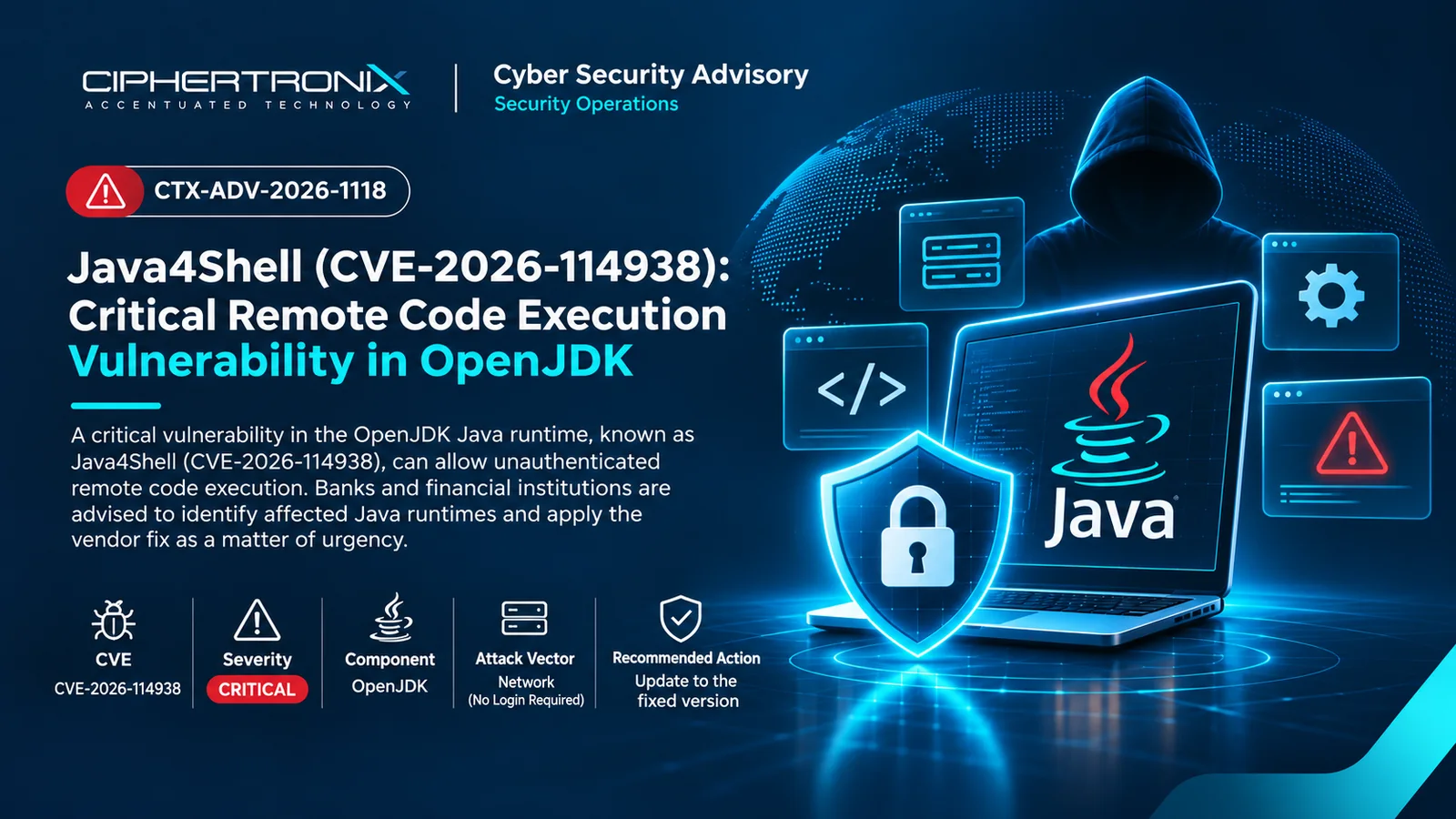
- Advisory ref.
- CTX-ADV-2026-1118
- Date of issue
- 18 November 2026
- Severity
- CRITICAL
- Classification
- TLP:CLEAR
- Audience
- Banks, DFIs, microfinance banks, PSOs/PSPs and fintech partners
- CVE
- CVE-2026-114938
1. Executive summary
Ciphertronix Security Operations is issuing this advisory about a critical vulnerability in the Java runtime known as Java4Shell (CVE-2026-114938). It is a heap-based out-of-bounds write in the x86-64 hardware-accelerated Base64 decoder in HotSpot. Malformed padding can underflow an output-length calculation, producing an invalid write mask. The vulnerability was discovered and disclosed by the security firm Calif. The OpenJDK project released the fix on 17 November 2026.
Java runs a large share of banking software: core banking interfaces, middleware, payment gateways, identity platforms and CI/CD tooling. Ciphertronix therefore recommends that every institution identifies its affected Java runtimes and patches them as a matter of urgency.
2. Vulnerability details
| Item | Detail |
|---|---|
| CVE ID | CVE-2026-114938 |
| Name | Java4Shell |
| Component | OpenJDK HotSpot, x86-64 Base64 decoding intrinsic |
| Severity | Critical. Oracle rates it 8.1 (CVSS v3.1), and Calif rates it 9.2 (CVSS v4.0). |
| Attack vector | Network. The attacker needs no account where the application decodes Base64 data from requests without requiring a login first. |
| Affected platform | The vulnerable code runs only on x86-64 Intel and AMD chips that support the AVX-512 VBMI feature. Calif says ARM64 is not affected. |
| Exploitation status | The Canadian Centre for Cyber Security reported no known active exploitation in its 17 November 2026 alert. |
3. Technical overview
An unauthenticated remote attacker may be able to execute arbitrary code on an affected system by sending specially crafted Base64 input. Malformed input can cause an AVX-512 routine to write 62 or 63 bytes beyond the allocated output array. Heap memory can be corrupted before the decoder rejects the input.
The optimised code path must be selected, typically after JIT compilation. Exploitability depends on the CPU, JVM configuration, and how the application handles attacker-controlled input. In the researchers’ own testing, the flaw let attackers without an account run their own code on Jira, Jenkins, Keycloak, and three other widely used applications.
4. Affected and fixed Java versions
| Java version | Affected builds | Recommended fixed version |
|---|---|---|
| Java 8 (Oracle Enterprise Performance Pack) | 8u511b33-perf | 8u513-perf |
| Java 8 (standard OpenJDK) | Not affected by this CVE | Latest November 2026 update |
| Java 11 | Not affected by this CVE | Latest November 2026 update |
| Java 17 | 17.0.6 to 17.0.21.0.3 | 17.0.21.1 |
| Java 21 | All releases up to 21.0.13.0.3 | 21.0.13.1 |
| Java 25 | All releases up to 25.0.5.0.3 | 25.0.5.1 |
| Java 27 | All releases up to 27.0.1.0.3 | 27.0.1.1 |
Other distributions. OpenJDK-based distributions are also affected: Eclipse Temurin, Amazon Corretto, Azul Zulu, Microsoft Build of OpenJDK, BellSoft Liberica, SAP SapMachine and Red Hat build of OpenJDK. These vendors release fixes on their own schedules. Amazon Corretto’s fixed builds are 17.0.21.1.2, 21.0.13.1.2, 25.0.5.1.2 and 27.0.1.1.4.
Important. The vulnerable October builds and the fixed November re-spins carry the same version numbers. “17.0.21” can be either. Confirm the build date, which must be 17 November 2026 or later, as well as the version number.
5. Potential impact
- Remote code execution on servers running affected Java applications
- Memory corruption, causing JVM crashes and service outages
- Disclosure of sensitive information held in memory, including credentials, session tokens and customer data
- Disruption of digital banking, payment and integration services that depend on Java
6. Recommended actions
6.1 Immediate, within 72 hours
- Inventory all Java runtimes, including those bundled in products and containers, and match them to vendor advisories.
- Prioritise internet-facing authentication systems, CI/CD services, enterprise application servers, and services that process untrusted Base64.
- Update to a fixed, vendor-confirmed build, rebuild container images, and restart all Java processes.
6.2 Temporary workaround, where patching is delayed
- Start affected JVMs with
-XX:-UseBASE64Intrinsics. This is preferred because it targets only Base64 decoding. - Verify the flags after restart. Workarounds do not remove the vulnerable code.
- WAFs, reverse proxies, and request buffering do not reliably prevent exploitation. Library updates alone do not fix a bundled vulnerable JVM.
6.3 Ongoing
- Restrict public exposure, enforce Base64 input size limits, validate inputs at boundaries, and reduce unauthenticated functionality.
- Ask third-party software vendors (core banking, AML, card management, HR and ERP systems) to confirm in writing which Java runtime their products bundle, and when their fixes will be available.
- Report suspected incidents through the relevant regulatory and national cyber security channels, including the State Bank of Pakistan and National CERT, in line with applicable requirements.
7. Detection and verification
| Step | What to do |
|---|---|
| Identify the runtime | Check java -version, resolve the binary path, and inspect running processes with ps. Use jcmd to review VM.command_line and VM.flags for the Base64 and AVX settings. |
| Check the CPU | The relevant flags are avx512f, avx512bw, avx512vbmi, and bmi2 in /proc/cpuinfo. Remember to check virtual machines and autoscaled hosts as well. |
| Indicators to monitor | Unexpected JVM crashes or restarts, unusual decoding or authentication errors, unexpected child processes, new scheduled tasks, web-shell artefacts, anomalous outbound connections, and unexplained file or secret changes. |
| Caution | Do not test production services with public exploits or crash triggers. |
| If compromise is suspected | Preserve evidence, check for credential exposure and persistence, and contact your CSIRT. Patching does not undo a prior compromise. |
8. How Ciphertronix can assist
| Service | Scope |
|---|---|
| Java runtime exposure assessment | Identification of affected runtimes across servers, containers and vendor-supplied applications. |
| Patch verification | Confirmation that fixed builds and workarounds are correctly applied and active. |
| Compromise assessment | Log, process and endpoint review for signs of exploitation. |
| Vulnerability assessment and penetration testing | A safe, controlled review of internet-facing Java applications. |
9. References
- Oracle Critical Patch Update, November 2026
- OpenJDK Vulnerability Group advisory, 17 November 2026
- CERT-EU Security Advisory 2026-021
- CIRCL TR-104: Critical Memory Corruption in OpenJDK Base64 Decoder
Disclaimer. This advisory is provided for information purposes to assist institutions in strengthening their security posture. It is based on information available at the date of issue, and vendor guidance may change. Institutions should evaluate the recommendations against their own environments and regulatory obligations.