- Advisory ref.
- CTX-ADV-2026-1118-B
- Date of issue
- 20 October 2026
- Severity
- CRITICAL (Actively Exploited)
- Classification
- TLP:CLEAR
- Audience
- Banks, DFIs, microfinance banks, PSOs/PSPs and fintech partners
- CVEs
- CVE-2026-109618, CVE-2026-109619
1. Executive summary
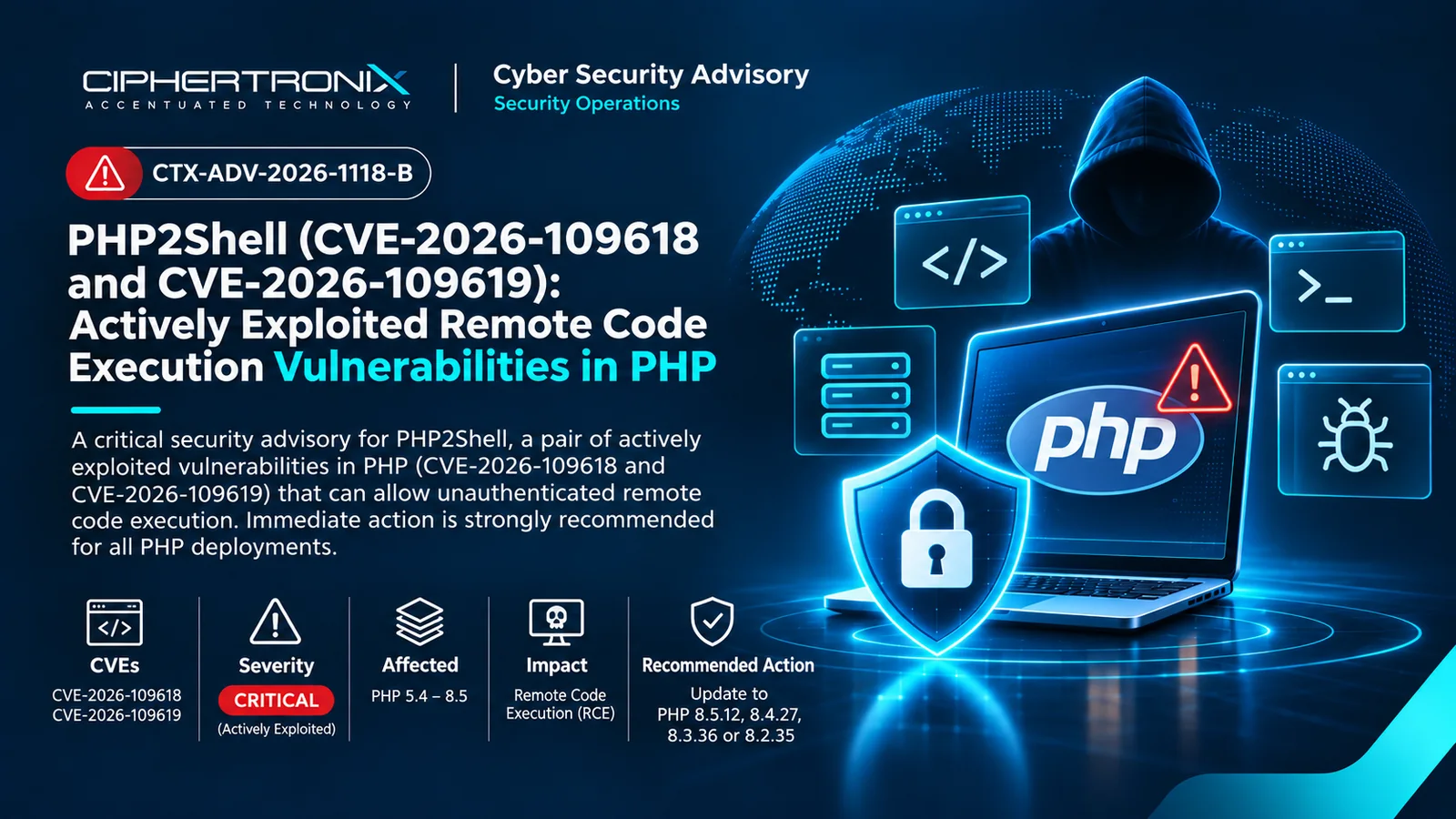
Ciphertronix Security Operations is issuing this advisory about PHP2Shell. PHP2Shell is a pair of high-impact vulnerabilities (CVE-2026-109618 and CVE-2026-109619) concerning memory safety flaws in PHP versions 5.4 to 8.5 that allow remote code execution (RCE). These vulnerabilities were estimated to affect nearly 70% of websites at the time of their disclosure.
The PHP development team has released emergency security updates. The fixes are in PHP 8.5.12, 8.4.27, 8.3.36 and 8.2.35, and the team is strongly urging all PHP users to update immediately. CISA added both CVEs to its Known Exploited Vulnerabilities catalogue on 26 October 2026. Any institution still running an unpatched PHP installation that serves web requests should treat it as potentially compromised and act immediately.
2. Vulnerability details
| Item | Detail |
|---|---|
| CVE-2026-109618 | RCE via out-of-memory corruption. If memory runs out mid-request, request data can be left partly set up, and cleanup may treat that broken data as valid. |
| CVE-2026-109619 | RCE via stale global state. Request-tied internal state can outlive its freed memory and be used by a later request on the same worker before it resets. |
| Severity | Critical. Both vulnerabilities carry a CVSS v4.0 score of 9.2. |
| Attack vector | Network. No authentication is required. |
| Exploitation status | Actively exploited. The vulnerabilities are listed in the CISA Known Exploited Vulnerabilities catalogue. |
3. Affected deployments
This affects every PHP installation that serves web requests, including PHP-FPM, Apache with mod_php, php-cgi, FrankenPHP and LiteSpeed. mod_php setups face the greatest danger. A working exploit has reportedly shown that one unauthenticated request can trigger the attack before any application code runs.
Network and security appliances. Palo Alto Networks says all PAN-OS and Panorama versions are affected by PHP2Shell, and no fixed PAN-OS release has shipped yet. Fortinet and Cisco have published advisories, but neither had confirmed a vulnerable product at the time of reporting. Check Point has reported intrusions through Mobile Access portals consistent with both CVEs.
4. Affected and fixed PHP versions
| PHP branch | Status | Recommended fixed version |
|---|---|---|
| 8.5 | Affected before 8.5.12 | 8.5.12 |
| 8.4 | Affected before 8.4.27 | 8.4.27 |
| 8.3 | Affected before 8.3.36 | 8.3.36 |
| 8.2 | Affected before 8.2.35 | 8.2.35 |
| 8.1, 8.0, 7.4 | Affected; end of life | Upgrade to a supported branch, or apply a vendor or LTS backport |
| 7.3 and older (including 5.x) | Affected; end of life, no fix from PHP | Upgrade to a supported branch |
Note. Vendor distributions may ship backported fixes without changing the upstream version number. Confirm patch status against your Linux distribution’s or vendor’s security advisory, not the version number alone.
5. Potential impact
- Unauthenticated remote code execution on web servers, portals and appliances running PHP
- Installation of web shells, backdoors and destructive malware; attackers have already deployed a data-wiping tool against some targets
- Theft of credentials, session data and customer information processed by PHP applications
- Use of compromised servers as a foothold into internal banking networks
6. Recommended actions
6.1 Immediate, within 24 hours
- Identify every system running PHP, including internet banking portals, corporate websites, internal web applications, VPN portals and security appliances.
- Upgrade to PHP 8.5.12, 8.4.27, 8.3.36 or 8.2.35, or apply your vendor’s patched packages, then restart all PHP workers and web servers.
- The UK NCSC urges taking offline any system that cannot be fixed right away.
- Apply vendor fixes, or the vendor’s published mitigations, for affected appliances such as Palo Alto PAN-OS and Panorama, and Check Point Mobile Access.
6.2 Temporary mitigations, only where patching is delayed
These reduce exposure but do not make a system safe. Upgrading is the only complete fix.
- For CVE-2026-109618: set
memory_limit=-1in a way applications cannot override. Lowerpost_max_size(8M without file uploads, 32M with them). Enforce request size and count limits at the web server or proxy. - For CVE-2026-109619: set
session.upload_progress.enabled=0and restart every worker. On PHP 8.5, setfatal_error_backtraces=0. - Set
expose_php=Off. A WAF is a temporary supporting control only. - Disabling upload progress alone does not fully protect against PHP2Shell.
6.3 Ongoing
- Replace end-of-life PHP branches (8.1 and older) with supported versions.
- Ask third-party software and appliance vendors to confirm in writing whether their products include PHP, and when fixes will be available.
- Report suspected incidents through the relevant regulatory and national cyber security channels, including the State Bank of Pakistan and National CERT, in line with applicable requirements.
7. Detection and indicators
| Check | What to look for |
|---|---|
| Web runtime | php -v checks the command-line install, which may differ from the runtime serving web requests. Verify the version of the PHP-FPM or Apache module actually serving pages. |
| Request anomalies | Multipart POSTs containing PHP_SESSION_UPLOAD_PROGRESS from unfamiliar sources, especially uploads named MARKER_ plus eight hexadecimal characters. Memory-limit errors during request setup, repeated HTTP 500 errors, and oversized or malformed PHPSESSID cookies. |
| Process anomalies | Alert when php-fpm, php-cgi, httpd or apache2 spawns shells, script interpreters, or download tools such as curl or wget. |
| Look back far enough | Review logs from before 21 October, since exploitation attempts began on 17 October. |
| Known indicator | IP address 206.188.197.105, identified as an attacker staging and operations server. |
| If compromise is suspected | Isolate the server, preserve web and PHP logs, and hunt for web shells, new files in the web root, new cron jobs or scheduled tasks, and unexpected accounts. Patching does not remove an attacker who is already inside. |
8. How Ciphertronix can assist
| Service | Scope |
|---|---|
| PHP exposure assessment | Identification of PHP runtimes across web servers, portals, containers and appliances. |
| Patch and configuration verification | Confirmation that fixed versions and temporary mitigations are correctly applied. |
| Compromise assessment | Web shell hunting, log review and analysis of servers that were exposed before patching. |
| Vulnerability assessment and penetration testing | A controlled review of internet-facing web applications. |
9. References
- PHP Security Advisories GHSA-w8hw-w9fx-j79w and GHSA-6wmf-4rv5-p3rp
- CISA Known Exploited Vulnerabilities Catalogue (entries added 26 October 2026)
- Palo Alto Networks, Fortinet, Cisco and Check Point vendor advisories
Disclaimer. This advisory is provided for information purposes to assist institutions in strengthening their security posture. It is based on information available at the date of issue, and vendor guidance may change. Institutions should evaluate the recommendations against their own environments and regulatory obligations.